











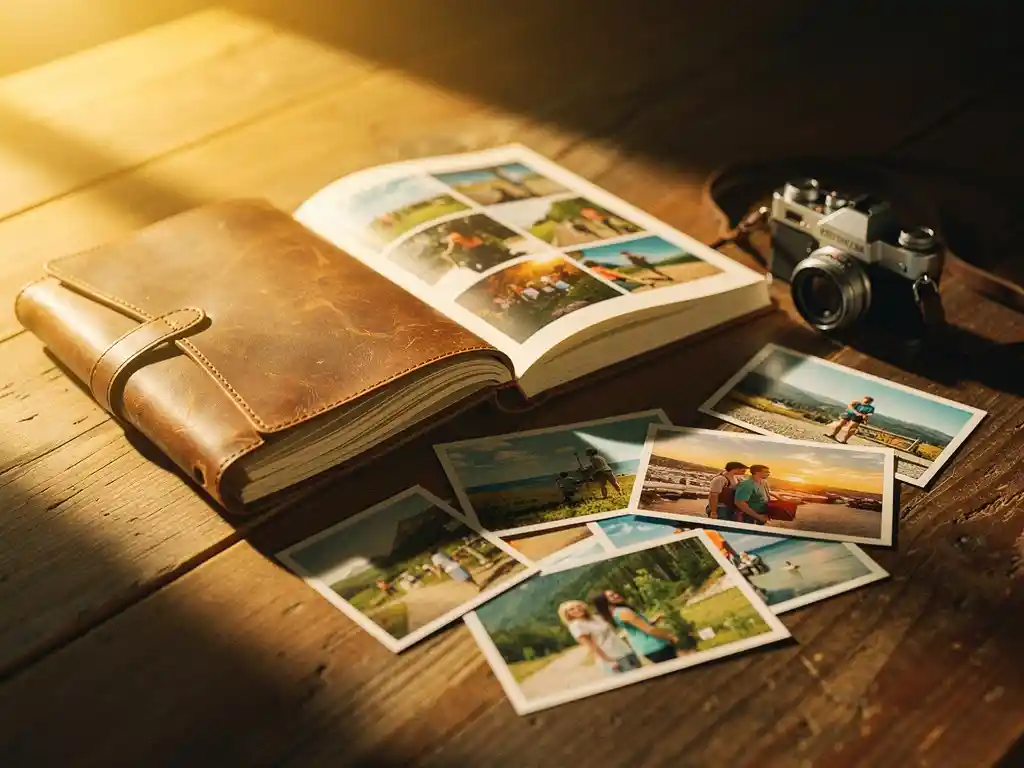
You turn travel photos into meaningful memories by giving them a permanent, tangible form — not leaving them buried in a camera roll. The act of curating, organizing, and printing your best images transforms a passive collection of files into a story you can hold, share, and revisit for years. Below, we answer the most common questions travelers ask about preserving their adventures.
Why do travel photos lose their emotional impact over time?
Travel photos lose their emotional impact because they remain invisible. When images sit unseen in a phone gallery or cloud storage, the feelings attached to them fade alongside the memories themselves. The problem is not the quality of the photos — it is the lack of engagement with them after the trip ends.
Human memory is reconstructive, meaning we rely on cues to trigger emotional recall. A photo viewed regularly keeps a memory vivid. One buried under thousands of newer images effectively disappears. Add to that the sheer volume of photos most travelers take today, and the result is a library that feels overwhelming rather than nostalgic. The emotional connection to a sunset in Santorini or a market in Marrakech weakens not because the experience was less meaningful, but because nothing brings it back to the surface.
The fix is not to take fewer photos. It is to do something with them before the holiday feeling fades completely.
What makes a travel photo truly memorable?
A truly memorable travel photo captures something specific: a genuine emotion, an unexpected moment, or a detail that transports you back to a place. Technical quality matters, but context and authenticity matter more. A slightly blurry shot of your child laughing on a beach will outlast a perfectly composed but emotionally empty landscape.
When reviewing your travel images, look for photos that do one or more of the following:
- Show real people in real moments, not posed for the camera
- Capture a detail unique to that destination — a street sign, a dish, a texture
- Tell a sequence — arrival, exploration, a shared meal, a farewell
- Evoke a feeling you want to revisit, even if the composition is imperfect
The most meaningful travel photo books are not collections of the technically best shots. They are collections of the most honest ones — the images that, taken together, tell the story of what it actually felt like to be there.
How do you organize hundreds of travel photos without spending hours?
The most efficient way to organize travel photos is to sort by date and location immediately after returning from a trip, before the sequence of events blurs in your memory. Start broad — group by trip or destination — then work inward by day or activity. Delete obvious duplicates and low-quality shots in this first pass.
A few practical steps that keep the process manageable:
- Sort by date first. Most phones and cameras timestamp images automatically. Use this to establish a chronological narrative before making any creative decisions.
- Create destination folders. Separate a two-week trip into smaller albums by city or activity. This makes the collection less overwhelming and easier to share selectively.
- Remove duplicates early. Burst shots and near-identical frames inflate your library fast. Culling them early saves time at every later stage.
- Use AI-assisted tools. Several platforms can automatically detect image quality, flag duplicates, and group similar photos — dramatically reducing the manual effort required to organize travel photos into a usable set.
The goal at this stage is not perfection. It is a clean, navigable collection you can actually use when it comes time to preserve travel memories in a lasting format.
What’s the best way to preserve travel memories long-term?
The best way to preserve travel memories long-term is to create a physical, printed keepsake. Digital files are fragile — they get lost when phones break, accounts close, or storage services change their terms. A printed travel photo book, by contrast, exists independently of any platform and does not require a device to enjoy.
Beyond printing, a few habits extend the life and emotional richness of travel memories:
- Add captions and dates. Context is what separates a meaningful keepsake from a random photo collection. Even brief notes — a place name, a person’s reaction, a funny detail — make images far more powerful to revisit years later.
- Back up digitally in multiple places. Cloud storage combined with a local backup protects against accidental loss. Use this as a safety net, not as your primary memory format.
- Commit to a format you will actually use. A travel memory keepsake only works if you revisit it. A printed photo book on a shelf is far more likely to be picked up than a folder buried on a hard drive.
The combination of a physical printed product and a reliable digital backup gives your travel memories the best chance of surviving intact for decades.
How do you turn travel photos into a photo book?
To turn travel photos into a photo book, start by selecting the images that best tell your trip’s story, then arrange them in a logical order — usually chronological — and add captions where context adds meaning. The result is a curated narrative rather than a raw dump of every image taken.
The traditional approach involves manually selecting photos, designing layouts, and placing images page by page — a process that can take hours or even days for a longer trip. AI-powered platforms have changed this significantly. By selecting a date range, a specific location, or an existing album, the technology can automatically analyze image quality, remove duplicates, and arrange your best travel photos into a designed layout in under a minute.
Whether you build your travel photo book manually or with AI assistance, the core principle is the same: choose images that together tell a story, not just the ones that look best in isolation. A travel photo book works best when it has a beginning, a middle, and an end — arrival, experience, departure — because that structure mirrors how we actually remember a trip.
When is the best time to create a travel photo book?
The best time to create a travel photo book is as soon as possible after returning from your trip — ideally within the first week. Memory is sharpest immediately after an experience, which means captions are more accurate, sequences are easier to reconstruct, and the emotional connection to the images is still vivid.
Waiting weeks or months has a real cost. The details that make captions meaningful start to blur. The motivation to sort through hundreds of images fades as everyday life resumes. Many travelers find that a photo book they intended to create never gets made at all because the window of enthusiasm closed before they started.
That said, the second-best time is always now. A travel memory keepsake created from a trip taken years ago still carries enormous value — especially if the photos have never been organized or printed before. Milestones like anniversaries, birthdays, or the end of a year are natural prompts to revisit old travel photos and finally give them the permanent form they deserve.
How PastBook helps you preserve travel memories
We built PastBook specifically to remove the friction that stops most travelers from ever turning their photos into something lasting. Here is what we offer:
- AI-powered curation in under 60 seconds. Our platform automatically selects your best travel photos, removes duplicates and low-quality images, and arranges them into a beautifully designed layout — no blank page, no manual sorting required.
- Import from anywhere. Pull photos directly from your phone, Instagram, Facebook, Google Drive, or Dropbox — wherever your travel memories happen to live.
- Premium printed quality. Books are printed on FSC-certified paper in soft cover, hardcover, and premium hardcover formats, in A4 and A5 sizes, and shipped worldwide through our global network of local printers.
- Start from a location or date range. Select a specific trip, destination, or time period and we handle the rest — making it effortless to document individual adventures as standalone keepsakes.
- Collaborative albums. Friends and family can contribute their own photos to a shared album, so no great shot from your trip gets left out.
Your travel photos deserve more than a folder on a phone. Create your travel photo book with PastBook today and turn your best adventures into a keepsake you will actually hold onto.