











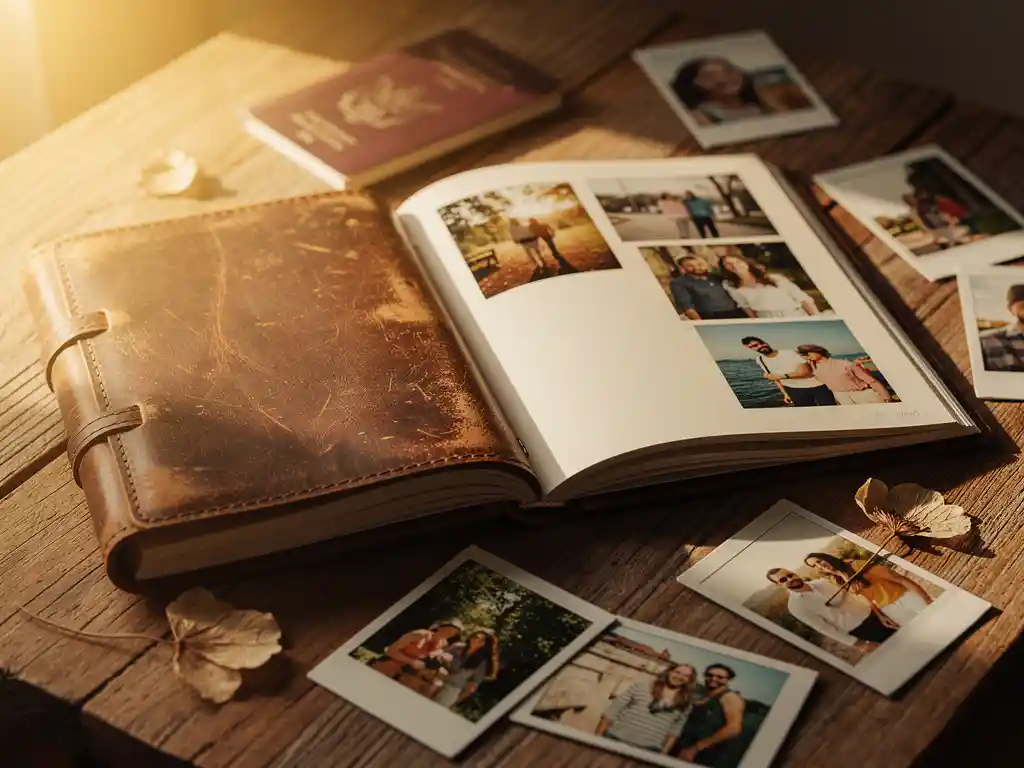
The best way to revisit travel memories years later is to keep them in a physical, tangible format you can return to without searching through thousands of digital files. A printed travel photo book gives you instant access to the story of a trip, organized, curated, and ready to relive whenever nostalgia strikes. Below, we unpack why memories fade, what actually preserves them, and how to turn scattered travel photos into something you will genuinely return to.
How do travel memories fade — and what actually slows that process?
Travel memories fade because the brain naturally deprioritizes experiences it no longer actively encounters. Without regular cues, details dissolve over time: the name of that restaurant in Lisbon, the exact light on a Kyoto morning, the feeling of arriving somewhere new. The memories that survive longest are the ones that get revisited, retold, or physically anchored.
Research in memory science consistently shows that retrieval strengthens recall. Every time you revisit a memory, you reinforce it. This is why storytelling, journaling, and looking at photos all slow the fading process. But not all formats are equally effective. Scrolling through a camera roll is passive and overwhelming. Flipping through a curated photo book is a deliberate act of remembering, which is far more powerful.
What genuinely slows memory fade is any habit that brings you back to the experience with context: photos paired with locations and dates, a narrative arc that mirrors how a trip actually unfolded, and a format you return to naturally rather than one buried in a cloud folder.
What are the best ways to relive travel memories years later?
The most effective ways to relive travel memories years later are the ones that combine visual cues with context and make the experience of remembering feel easy and enjoyable rather than like a chore. The format matters as much as the content.
Here are the approaches that work best over the long term:
- Printed photo books: A curated, chronological book of travel photos is the single most immersive way to revisit a trip. It puts you back in the story without requiring you to search, scroll, or organize anything in the moment.
- Travel journals paired with photos: Written notes alongside images add a layer of personal detail that photos alone cannot capture, especially when capturing how something felt rather than just how it looked.
- Printed photo calendars: Displaying travel images throughout the year keeps memories present in daily life rather than locked away in an app.
- Organized digital albums with captions: If print is not an option, a well-labeled digital album with dates, locations, and brief descriptions is far more revisitable than an unorganized camera roll.
- Sharing with travel companions: Revisiting memories together, whether through a shared album or a printed book, reinforces the experience for everyone involved and adds new perspectives you may have forgotten.
Of these, printed formats consistently outperform digital ones for emotional resonance and long-term accessibility, which brings us to the next question.
Why are printed photo books better than digital albums for reliving trips?
Printed photo books are better than digital albums for reliving travel memories because they remove friction entirely. You do not need a device, a password, or a subscription. You pick up the book and you are immediately inside the trip. The physical act of turning pages also engages memory in a way that scrolling simply does not.
Digital albums carry a hidden cost: they require maintenance. Apps change, platforms shut down, storage fills up, and photo libraries become overwhelming. A photo book, by contrast, is permanent and self-contained. It does not need updating, backing up, or organizing after the fact.
There is also an emotional dimension to holding something physical. A printed book signals that the trip mattered enough to preserve properly. That perceived effort, even when the creation process was effortless, makes the object feel more meaningful to both the person who made it and anyone they share it with. This is why travel photo books make such effective gifts as well as personal keepsakes.
Finally, printed books are shared differently. They sit on coffee tables, get passed around at family gatherings, and invite conversation in a way that a phone screen never does. That social dimension is a powerful extension of the memory itself.
How do you turn years of scattered travel photos into a photo book?
Turning years of scattered travel photos into a photo book comes down to three steps: gathering your images from wherever they live, selecting the best ones for a specific trip or time period, and arranging them into a layout. The challenge most people face is that the second and third steps feel overwhelming when done manually.
Here is a practical approach to making it manageable:
- Start with one trip, not all of them. Trying to document every journey at once leads to paralysis. Pick a single destination or year and commit to that first.
- Pull images from all your sources. Travel photos tend to live across multiple platforms: your phone’s camera roll, Instagram, Facebook, Google Drive, Dropbox. Consolidating them before you start saves time later.
- Filter ruthlessly. The best travel books are curated, not comprehensive. Aim for the images that tell the story, not every photo you took. Remove duplicates, blurry shots, and near-identical frames.
- Organize chronologically or by location. A narrative structure, whether day-by-day or destination-by-destination, makes the book far more enjoyable to revisit than a random collection.
- Choose a format and print it. Decide on size and cover type, then commit. A book you never print is a book that never gets revisited.
If the manual process feels like too much, AI-powered platforms can handle the curation and layout automatically, turning a potentially hours-long task into something that takes under a minute.
When is the best time to create a travel memory book?
The best time to create a travel memory book is as soon as possible after the trip ends, while the emotional connection to those photos is still strong. The longer you wait, the harder it becomes to remember which images mattered most and why. That said, any time is better than never, and older trips often carry a deeper nostalgia that makes the process even more rewarding.
There are a few natural moments when people find themselves most motivated to preserve travel memories:
- Immediately after returning from a trip: The holiday feeling is still fresh, and you are most likely to remember the context behind each photo.
- At the end of the year: The turn of a new year naturally prompts reflection and a desire to capture what the past twelve months held, including every trip taken.
- Before a milestone anniversary or birthday: A photo book documenting a shared journey makes an extraordinarily personal gift.
- When you stumble across old photos: If you find yourself scrolling through images from a trip you had almost forgotten, that is the moment to act on the impulse rather than let it pass.
The emotional window matters. Nostalgia is a powerful motivator, and a travel photo book created in that window will reflect the feeling of the trip far more authentically than one assembled years later from cold memory.
How PastBook helps you preserve travel memories
We built PastBook specifically to remove every barrier between your travel photos and a finished, printed photo book. Whether your images are on your phone, Instagram, Facebook, Google Drive, or Dropbox, our AI-powered platform pulls them together and does the hard work for you.
Here is what we take care of automatically:
- Smart photo selection: Our AI analyzes image quality and context, removes duplicates and blurry shots, and picks the best images from your chosen trip, date range, or location.
- Instant layout design: Photos are grouped and arranged into beautifully designed page layouts in under 60 seconds. No blank pages, no manual dragging and dropping.
- Flexible import options: Connect your social accounts or upload directly from your device. We support Facebook, Instagram, Google Drive, Dropbox, and personal photo libraries.
- Premium print quality: Books are printed on FSC-certified paper in soft cover, hardcover, and premium hardcover formats, in A4 and A5 sizes, and shipped worldwide.
- Collaborative albums: Friends and family can add their own photos from the same trip, so no moment goes uncaptured.
The result is a photo book that looks like you spent hours on it, even though you spent less than a minute. If you have travel photos waiting to become something more, create your photo book with PastBook today and relive those memories in the format they deserve.