











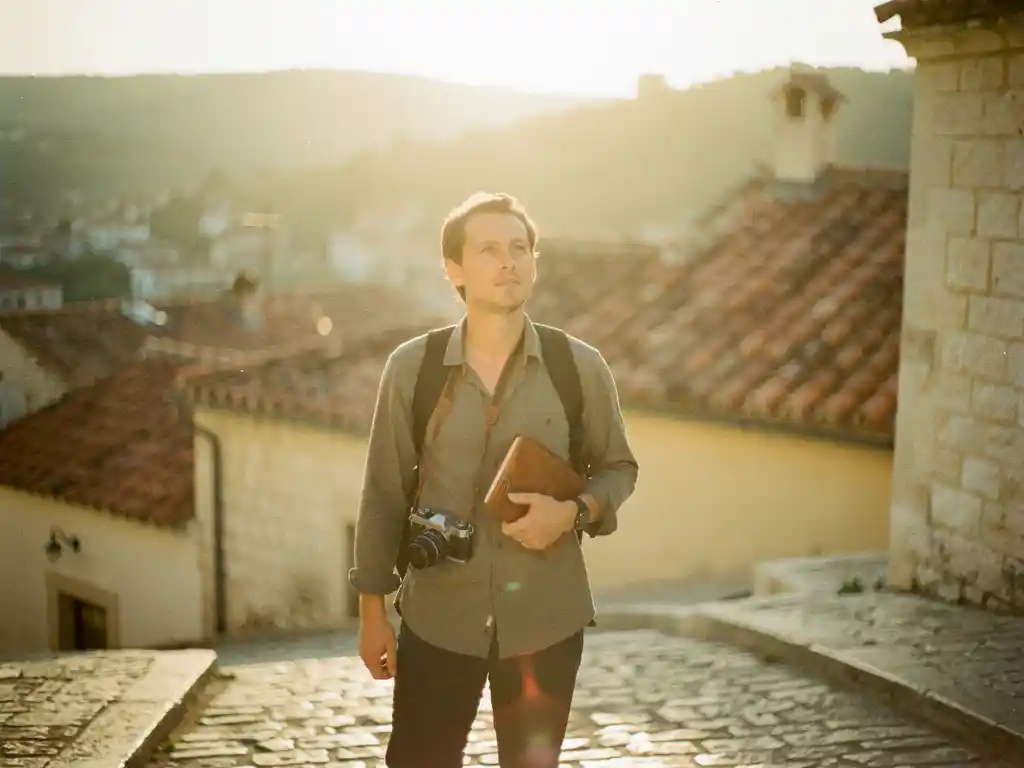
Both. The most fulfilling travel experiences come from knowing when to put the camera down and when to pick it up. Photography and presence are not opposites — they become a problem only when one consistently crowds out the other. The key is being intentional about how and when you document your journey, rather than shooting on autopilot. This article unpacks the most common questions travelers wrestle with around photography, presence, and preserving memories that actually last.
Does taking photos actually stop you from enjoying travel?
Taking photos does not automatically reduce your enjoyment of travel, but compulsive, unconscious photographing can create distance between you and the experience. When you spend more time framing a shot than absorbing a moment, the camera becomes a barrier rather than a tool. The issue is not photography itself — it is the habit of reaching for your phone out of reflex rather than intention.
Research in cognitive psychology suggests that when we photograph something with the expectation of reviewing it later, we sometimes pay less attention in the moment — a phenomenon sometimes called the “photo-taking impairment effect.” However, this effect is most pronounced when people photograph passively and without engagement. Actively composing a shot, by contrast, can actually deepen attention and sharpen observation skills.
Travelers who report the richest experiences tend to treat photography as a creative act, not a compulsive one. They choose specific moments to document, put the phone away in between, and allow themselves to be fully present for the stretches of a trip that do not need to be recorded. The camera is a guest on the journey, not the tour guide.
How many photos do travelers actually take on a trip?
The average traveler takes hundreds to thousands of photos on a single trip, with smartphone users often accumulating far more than they ever review or share. A week-long holiday can easily generate anywhere from 300 to over 1,000 images, especially when multiple people in a group are all shooting the same scenes from slightly different angles.
The result is a familiar problem: you return home with a camera roll so large it becomes overwhelming. Most of those photos never get sorted, shared, or printed. They sit in a folder — or scattered across multiple apps and devices — gradually fading from memory rather than preserving it.
This volume problem is worth understanding because it shapes how you should approach travel photography in the first place. Shooting less deliberately often produces more photos but fewer genuinely good ones. A smaller, curated collection of images that captures the real spirit of a trip is almost always more valuable than an enormous archive of near-identical shots.
What’s the difference between documenting and experiencing a trip?
Documenting a trip means creating a record of what happened. Experiencing it means being fully absorbed in what is happening as it unfolds. The difference is one of attention: documentation is outward-facing and future-oriented, while experience is present-focused and sensory. Both matter — but they require different mental modes, and switching between them takes conscious effort.
When you are in documentation mode, you are thinking about how something will look later: the angle, the light, the caption. When you are in experience mode, you are noticing how the food tastes, how the air smells, or how a place makes you feel. Neither mode is superior, but problems arise when documentation mode runs continuously throughout a trip, leaving no room for genuine immersion.
Signs you are over-documenting
- You feel anxious if you miss a photo opportunity, even when the moment itself was enjoyable
- You review and edit photos during the trip rather than at the end
- You choose activities or restaurants partly based on how photogenic they are
- You feel the need to photograph something before you allow yourself to enjoy it
Signs you have found the right balance
- You can recall specific sensory details of a trip, not just visual ones
- Your photos reflect genuine moments rather than staged compositions
- You sometimes leave your phone in your bag and feel comfortable doing so
- Looking back at your photos triggers real memories rather than just recognition
How can you capture travel memories without missing the moment?
The most effective approach is to set intentional photography windows rather than shooting continuously. Decide in advance when you will document — the first ten minutes after arriving somewhere, the golden hour before dinner, the final morning — and commit to being phone-free in between. This structure removes the constant micro-decision of whether to photograph each moment.
A few practical strategies that experienced travelers use:
- Front-load your photography. Spend the first few minutes in a new location taking the shots you want, then put the camera away and simply be there.
- Use a dedicated camera occasionally. A separate camera, rather than a smartphone, reduces the temptation to check notifications or scroll social media mid-trip.
- Photograph details, not just landmarks. Close-ups of a market stall, a local menu, or a worn door handle often trigger more vivid memories than wide shots of famous sights.
- Let someone else take the group shots. Rotating who handles the camera means everyone gets to be in the moment more of the time.
- Set a daily photo limit. Some travelers cap themselves at 20 or 30 photos per day, which forces more deliberate choices and produces a cleaner, more meaningful collection.
The goal is not to photograph less for its own sake, but to photograph with enough intention that every image you take actually earns its place in your travel memories.
What’s the best way to preserve travel photos after a trip?
The best way to preserve travel photos is to organize and transform them into a tangible format as soon as possible after returning home — before the emotional context fades and the images become just another folder buried on your device. Digital files are fragile in a practical sense: they get lost across platforms, buried under newer photos, and rarely revisited. A physical photo book, by contrast, is something you can return to again and again.
The longer you wait, the harder it gets. Most people intend to sort their travel photos eventually, but weeks turn into months, and the sheer volume of images makes the task feel insurmountable. Acting within the first week or two after a trip, while the memories are still vivid, makes the process far more meaningful and manageable.
How PastBook helps you preserve your travel memories
We built PastBook specifically for the moments after a trip ends — when you have hundreds of photos scattered across your phone, Instagram, and Google Drive, and no clear idea how to turn them into something lasting. Our AI-powered platform takes the effort out of the process entirely.
Here is what we handle automatically when you create a photo book for travel:
- Smart photo selection: Our AI analyzes your images for quality and context, picks the best ones, and removes duplicates — so you are not manually sorting through 800 near-identical sunset shots.
- Instant layout design: Photos are automatically grouped and arranged into beautiful page layouts, ready to review in under 60 seconds.
- Flexible import sources: Pull photos from Facebook, Instagram, Dropbox, Google Drive, or directly from your phone — wherever your travel memories live.
- Location-based albums: Start a book from a specific destination or date range, making it easy to create a dedicated keepsake for each trip.
- Premium print quality: Books are printed on FSC-certified paper in soft cover, hardcover, or premium hardcover formats, and shipped worldwide through our global printing network.
The result is a beautifully curated travel photo book that looks like you spent hours putting it together — because we did the heavy lifting for you. Ready to turn your last trip into something you can hold? Create your travel photo book with PastBook today.