











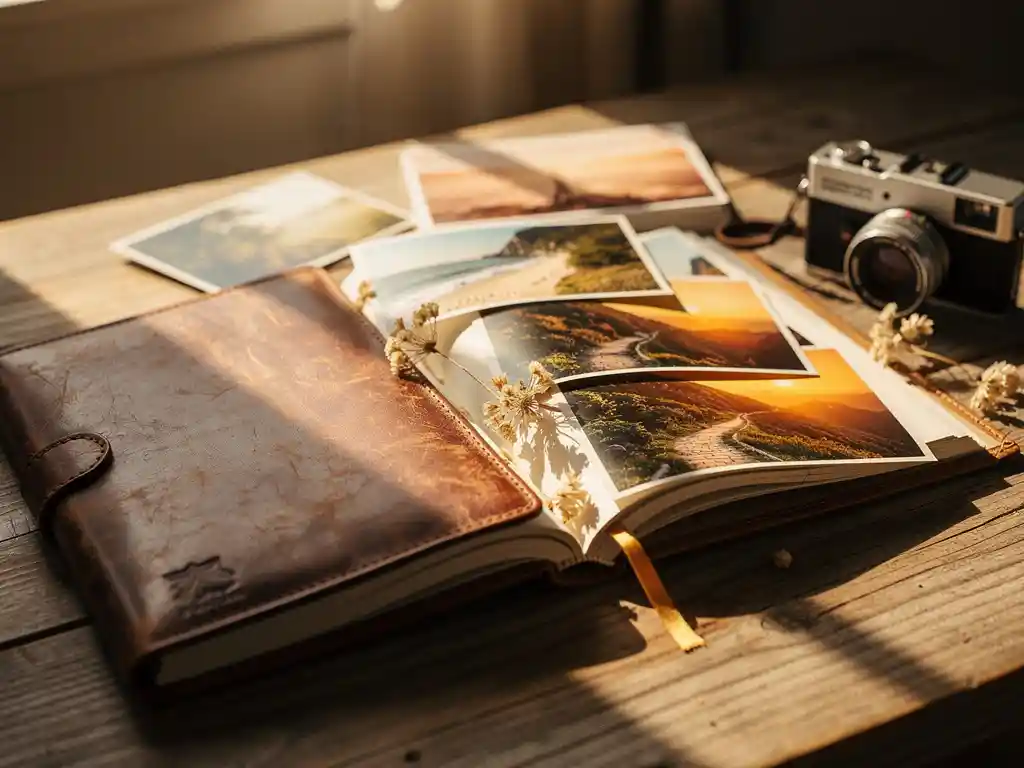
The best way to remember a vacation is to turn your photos into a physical keepsake, such as a printed photo book, as soon as possible after returning home. Tangible objects trigger memory recall far more effectively than scrolling through a camera roll, and the act of curating your trip reinforces the experience in your mind. The questions below walk you through exactly how to do that well.
How do you preserve travel memories that actually last?
Preserving travel memories that last means combining physical and intentional documentation. A printed photo book, a handwritten journal entry, or even a curated digital album with captions and dates will outlast any unorganized folder of files sitting on your phone. The key is giving your memories a structure that makes them easy to revisit years later.
Photos alone are not enough. Without context, even the most vivid images start to blur together after a few months. Adding captions, dates, and location details transforms a collection of snapshots into a story you can actually follow. Research in memory psychology consistently shows that we remember experiences better when we encode them with narrative, not just visuals.
Physical objects carry particular weight. A photo book sitting on your shelf will be picked up, flipped through, and shared in a way that a phone gallery rarely is. It becomes a conversation starter, a gift, and a record all at once. For travel memories specifically, the combination of chronological order, printed quality, and tactile experience makes photo books one of the most effective long-term memory tools available.
Why do vacation memories fade so quickly?
Vacation memories fade quickly because the brain prioritizes encoding new information over retaining old experiences, especially once you return to your daily routine. Without active reinforcement, the emotional intensity of a trip diminishes within days, and specific details, names, places, and moments begin to blur together.
This is sometimes called the “fading affect bias” in reverse: while we tend to remember positive emotions more than negative ones, the specificity of those memories still deteriorates rapidly. You might remember that a trip was wonderful without being able to recall what made a particular afternoon so special.
The post-trip transition back to work and routine accelerates this process. New experiences crowd out the old ones. This is exactly why the window immediately after returning from a trip is so valuable. Acting on your travel memories while the feelings are still fresh, before the holiday glow fades, produces far richer and more meaningful keepsakes than waiting weeks or months.
What’s the best way to organize hundreds of travel photos?
The best way to organize hundreds of travel photos is to sort them by date and location first, then filter by quality. Start by removing obvious duplicates, blurry shots, and near-identical images. From there, group the remaining photos by day or destination so the trip tells a clear, chronological story.
Here is a practical approach that works for most travelers:
- Back up everything first before making any deletions, whether to cloud storage or a hard drive.
- Do a rough cull by removing clear rejects, blurry images, and accidental shots.
- Group by day or location so each chapter of the trip is clearly defined.
- Select your best 10 to 20 images per day rather than trying to keep everything.
- Add captions or notes while the details are still fresh in your memory.
The hardest part for most people is the culling step. When you have taken 400 photos over two weeks, deciding which ones to keep can feel overwhelming. A useful rule is to ask yourself whether a photo adds something new to the story. If two shots are nearly identical, keep only the strongest one. The goal is a curated set of images that captures the spirit of the trip, not an exhaustive archive of every moment.
Should you make a photo book or a digital album for travel memories?
For travel memories you want to last, a printed photo book is the stronger choice. Digital albums are convenient and easy to share, but they are also easy to forget. A physical photo book sits on a shelf, gets picked up during quiet evenings, and can be passed around at family gatherings in a way that a link to an online gallery simply cannot replicate.
That said, the two formats serve different purposes and are not mutually exclusive.
When a digital album makes sense
Digital albums are ideal for sharing immediately after a trip, collaborating with travel companions who want access to the same photos, or archiving a large volume of images that would not all fit in a single book. They are also a practical first step before creating a physical product.
When a printed photo book wins
A printed photo book is the right choice when you want a memorable gift, a keepsake to display at home, or a record of a trip that genuinely matters to you. The physical format adds emotional weight that a screen cannot match. For milestone trips such as a honeymoon, a family holiday, or a solo adventure you have been planning for years, print is almost always the more meaningful outcome.
The good news is that you do not have to choose one or the other from the start. Many people create a digital album first for easy sharing, then use that curated set of images to produce a printed book as the lasting version.
How soon after a trip should you create a travel keepsake?
You should create a travel keepsake within one to two weeks of returning from a trip. This is when your memories are sharpest, your emotional connection to the experience is strongest, and the details that make a photo book feel personal, like specific captions, the name of a restaurant, or a funny moment on day three, are still accessible.
Waiting longer does not just risk fading memories. It also increases the likelihood that the project never gets done at all. Most people who say they will “get around to it eventually” find the task sitting untouched months later, by which point the holiday feeling has completely passed and motivation is low.
Acting quickly also means the keepsake serves its purpose as a vacation memory reinforcer. Flipping through a photo book two weeks after a trip, while you can still smell the destination and feel the rhythm of the days, is a fundamentally different experience from doing so a year later. The sooner you create it, the more it captures not just the images but the feeling of being there.
How PastBook helps you preserve every trip
We built PastBook specifically for travelers who come home with hundreds of photos and no time to sort through them all. Our AI-powered platform does the heavy lifting so you do not have to. Here is what that looks like in practice:
- Automatic photo selection: Our AI analyzes image quality, removes duplicates, and picks your best shots from a chosen date range, location, or album.
- Ready in under 60 seconds: From import to a print-ready layout, the entire process takes less than a minute. No blank pages, no manual arrangement.
- Multiple import sources: Pull photos directly from your phone, Instagram, Facebook, Google Drive, or Dropbox.
- Premium print quality: Our printed photo books are available in soft cover, hardcover, and premium hardcover formats, printed on FSC-certified paper and shipped worldwide.
- Perfect as a photo book gift: Because the finished product looks beautifully curated, it makes a genuinely thoughtful and memorable gift for travel companions, family members, or anyone who shared the journey with you.
The best time to turn your travel photos into something lasting is right now, while the memories are still vivid. Create your travel photo book with PastBook today and keep the feeling of your last adventure alive for years to come.