



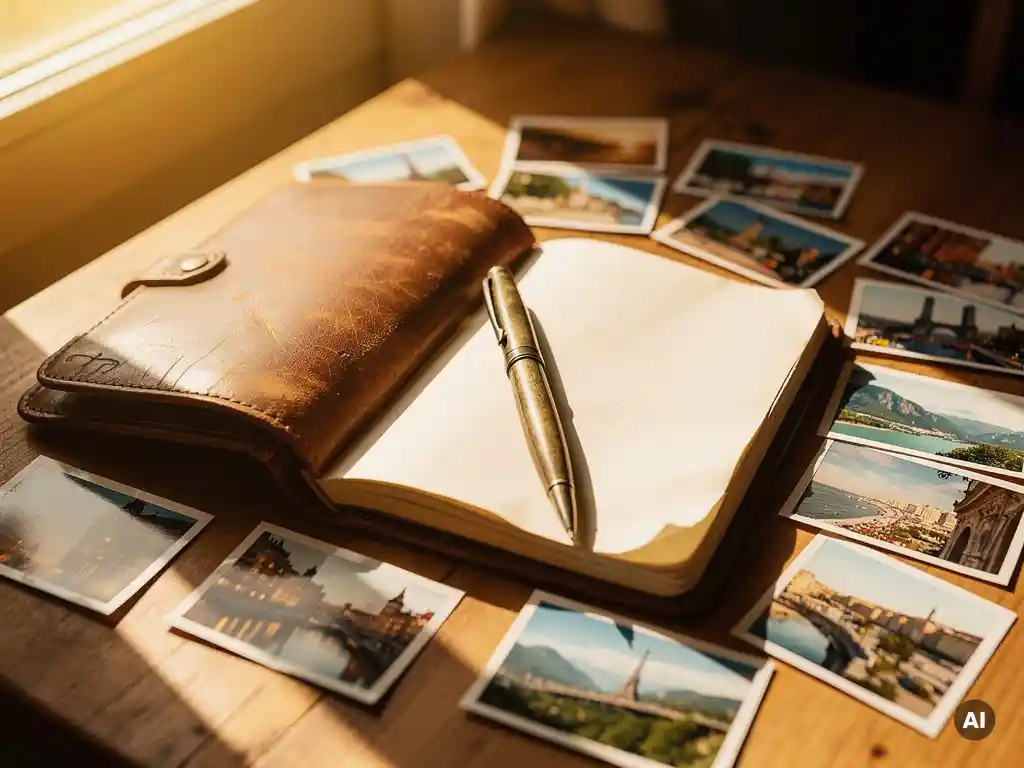
Writing about a trip helps make the memory last longer by forcing your brain to actively reconstruct and encode the experience rather than letting it fade passively. The act of putting your journey into words strengthens the neural pathways connected to those moments, making them easier to recall weeks, months, and even years later. Below, we unpack the most important questions around travel journaling and how to preserve your travel memories in ways that genuinely stick.
What details from a trip are easiest to forget?
The sensory and contextual details of a trip are the first to fade: the name of the tiny restaurant where you had the best meal, the exact route you wandered through a market, the small conversations with locals, and the specific feelings tied to a particular moment. These micro-details disappear within days, leaving only a general impression of the experience.
Our brains are not designed to store every detail with equal weight. They naturally compress memories over time, keeping the emotional highlights and discarding the granular texture. This is why, a month after returning home, you might clearly remember a stunning viewpoint but struggle to recall what day it was, who you were with, or what you ate beforehand.
The details most at risk include:
- Names of places, streets, restaurants, and local people you met
- The sequence of events and which day things happened
- Sensory impressions: smells, sounds, textures, and tastes
- Spontaneous moments that were not photographed
- Your emotional state at specific points in the journey
- Practical context, like weather, travel delays, or unexpected detours
These are precisely the details that bring a travel story to life when you relive it later, which is why capturing them quickly and deliberately matters so much.
How soon after a trip should you write about it?
You should write about a trip as soon as possible, ideally within 24 to 72 hours of returning home. Memory research consistently shows that recall accuracy drops sharply in the first few days after an experience. Writing while the sensory details are still vivid gives you the richest, most accurate account of what actually happened.
If a full write-up feels overwhelming immediately after travel, start small. Even a few bullet points jotted on your phone the evening after each day can serve as powerful memory anchors later. These quick notes do not need to be polished; they just need to capture the raw material: what you saw, how you felt, what surprised you.
For longer trips, consider writing in real time rather than waiting until the end. A few minutes of journaling each evening locks in the day’s details before they blur together. By the time you get home, you have a complete record rather than a vague impression of the whole trip as one merged experience.
What should you include when writing about a travel experience?
When writing about a travel experience, include a mix of factual details, sensory observations, personal reactions, and unexpected moments. The most memorable travel writing combines the concrete and the emotional, grounding the reader in a specific place while also conveying how it felt to be there.
A strong travel journal entry typically covers:
- Where and when: The location, date, and basic context of the day or moment
- What happened: A clear sequence of events, including the unplanned ones
- Sensory details: What you saw, heard, smelled, tasted, or touched that stood out
- People and conversations: Anyone memorable you encountered and what was said or shared
- Your emotional response: How you felt at different points, including moments of discomfort or wonder
- Surprises and discoveries: Anything that challenged your expectations or changed your perspective
Do not worry about writing beautifully in the moment. The goal is completeness over polish. You can always refine the language later, but you cannot recover details that were never recorded.
Does pairing photos with writing make memories stronger?
Yes, pairing photos with writing makes memories significantly stronger. Visual and verbal memory systems in the brain reinforce each other, so combining an image with a written description creates a richer, more durable memory trace than either alone. When you look at a photo and read your own words about that moment, you re-experience it from multiple angles simultaneously.
Photos alone can be misleading over time. Without context, a beautiful image loses its story. You might remember the scene but forget why it mattered, who you were with, or what happened just before or after the shutter clicked. Writing fills in that narrative gap.
The reverse is also true: writing without photos can feel abstract. A vivid description of a landscape is powerful, but pairing it with the actual image anchors the words in something tangible. Together, they create a complete record that is far more evocative than either format on its own.
This is one reason why a well-organized travel photo book, where images are grouped by date, location, or journey, works so well as a memory tool. When your photos are arranged in a meaningful sequence, they tell a story rather than existing as a disconnected archive.
What are the best formats for preserving travel stories long-term?
The best formats for preserving travel stories long-term are those that combine accessibility, durability, and emotional resonance. Digital notes and cloud-stored photos are convenient, but they are easy to ignore and vulnerable to platform changes. Physical formats, especially printed photo books paired with written captions or journals, tend to be the most enduring and emotionally meaningful over time.
The most effective long-term formats include:
- Printed travel photo books: A curated, chronological collection of your best images from a trip, ideally with captions that capture context and feeling. These can be revisited without a screen and make powerful gifts.
- Handwritten or digital travel journals: A dedicated journal for each trip, kept either in a notebook or an app like Day One, preserves the narrative thread of your experience.
- Annotated photo albums (digital or physical): Photos organized by location or date with short written captions strike a balance between visual and written memory.
- Blog posts or private online journals: Writing for a specific audience, even just yourself, encourages more complete and reflective storytelling.
- Combined formats: The strongest approach pairs a physical photo book with a personal journal, so the images and the words exist together and reinforce each other.
The key factor in any format is that it must be easy to revisit. A beautifully printed book sitting on a shelf will be picked up far more often than a folder buried in cloud storage. When you want to relive travel memories years later, friction is the enemy.
How PastBook helps you preserve travel memories
Writing about a trip is one of the best ways to make memories last, and pairing your words with beautifully organized photos takes that a step further. We built PastBook specifically to remove the biggest barrier to creating a lasting travel keepsake: the time and effort it takes to sort, select, and arrange hundreds of photos.
Here is what we do for you:
- AI-powered photo selection: Our platform automatically picks your best travel shots, removes duplicates and low-quality images, and arranges them into a curated layout, all in under 60 seconds.
- Flexible import options: Pull photos from Instagram, Facebook, Google Drive, Dropbox, or directly from your phone, no matter where your travel memories are stored.
- Premium printed photo books: Available in softcover, hardcover, and premium hardcover, printed on FSC-certified paper and shipped worldwide.
- Date- and location-based organization: Simply select a date range or trip album and we handle the rest, so your book tells the story of your journey in the right order.
Whether you are back from a weekend escape or a months-long adventure, do not let the memories fade before you capture them. Create your travel photo book with PastBook and turn your favorite journey into something you can hold in your hands.