











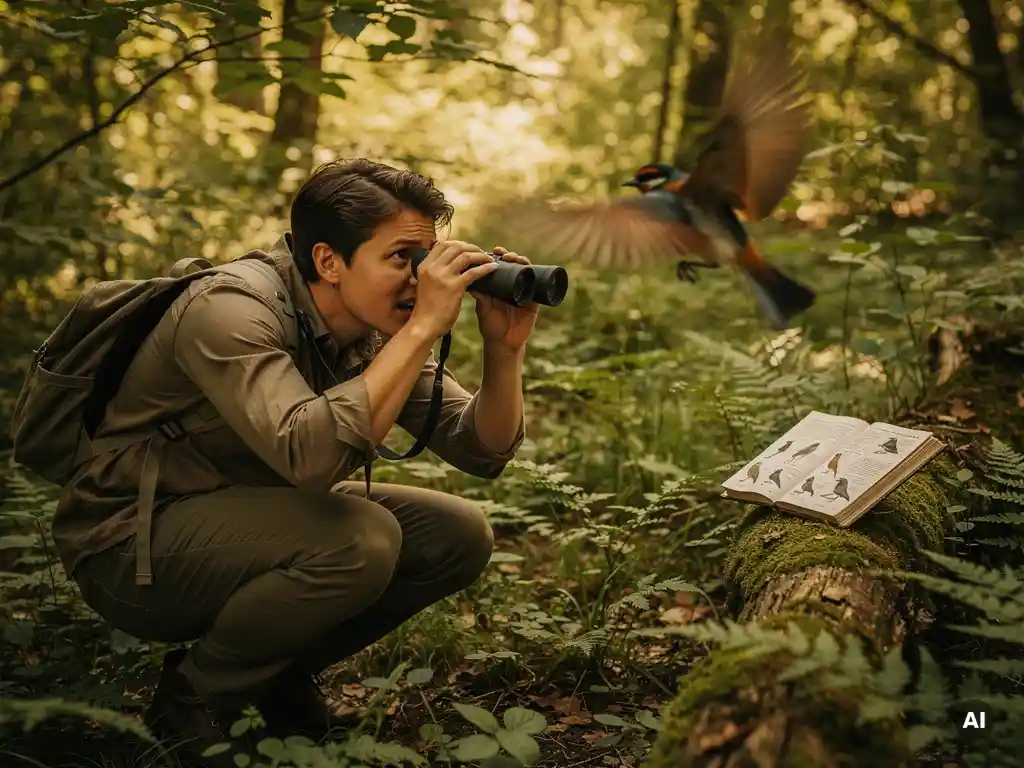
The most common birdwatching mistakes beginners make include moving too fast, choosing the wrong location, buying unnecessary gear, and trying to identify every bird they see. These errors are almost universal among new birdwatchers, and they tend to compound each other, poor gear choices lead to frustration, which leads to giving up before the skill has a chance to develop. The good news is that each of these beginner birdwatcher mistakes is entirely avoidable once you know what to watch out for.
Why do beginners struggle to spot birds in the wild?
Most beginners struggle to spot birds because they move too quickly, make too much noise, and don’t give their eyes time to adjust to the environment. Birds are acutely sensitive to movement and sound. The moment a person crashes through undergrowth or speaks at full volume, nearby birds fall silent or vanish entirely. Stillness and patience are the foundational skills of birdwatching, and they are the hardest habits to build.
There is also a perceptual learning curve that new birdwatchers underestimate. Experienced birders have trained their eyes to notice subtle movement in foliage, silhouettes against the sky, and the faint rustle of a bird foraging in leaf litter. That visual awareness takes time to develop. Beginners often scan too broadly, looking for a whole bird rather than learning to detect the small clues, a flicker of wings, a bobbing branch, that give a bird’s position away.
One practical fix is to arrive at your chosen spot early, settle in quietly, and simply wait. Give the local birds five to ten minutes to forget you are there. You will be surprised how much activity reveals itself when you stop chasing it.
What gear mistakes do beginner birdwatchers commonly make?
The most common gear mistake beginner birdwatchers make is either buying cheap, low-quality binoculars or over-investing in expensive equipment before they know what they actually need. Both extremes cause problems. Cheap binoculars produce blurry, dim images that make identifying birds genuinely difficult. Over-expensive setups can lead to frustration when the investment does not immediately translate into better sightings.
For most beginners, a mid-range pair of 8×42 binoculars offers the best balance of magnification, brightness, and ease of use. The 8x magnification is forgiving enough to keep moving birds in frame, while the 42mm objective lens gathers enough light for woodland and dawn conditions. Avoid 10x or higher magnification at first, the narrower field of view makes it much harder to locate a bird quickly.
Other common gear errors include:
- Wearing brightly coloured clothing that alerts birds to your presence
- Forgetting a field guide or relying solely on a phone app with poor offline capability
- Not bringing a notebook to record sightings, which slows down learning significantly
- Neglecting weather protection for both yourself and your equipment on longer outings
Start simple. Good binoculars, a regional field guide, and quiet, neutral-coloured clothing will take you further than any specialist gadget.
How does poor habitat selection affect birdwatching success?
Poor habitat selection is one of the most overlooked birdwatching mistakes beginners make, and it directly limits how many species you will ever see. Different bird species are tied to specific habitats, woodland edges, wetlands, open grassland, coastal mudflats, and visiting the wrong environment for the birds you hope to find will result in an empty afternoon regardless of your skill level.
Many beginners default to the nearest park or green space without researching what species live there or what time of year those species are present. Seasonal movement matters enormously. A wetland that is alive with wading birds in autumn may be almost empty in midsummer. Understanding the seasonal patterns of your local area transforms a frustrating outing into a productive one.
To choose better habitats, start with these steps:
- Use a local birdwatching society or app to find sites with recent sighting reports
- Research which habitat types host the species you want to see
- Visit at the right time of day, early morning is almost always the most active period
- Learn the seasonal calendar for your region so you know when migrants arrive and leave
What identification mistakes do new birdwatchers make most often?
The most frequent identification mistake new birdwatchers make is jumping to a conclusion based on a single feature, colour, size, or a brief glimpse, rather than observing the whole bird systematically. A bird seen in poor light or at an awkward angle can look very different from the same species illustrated in a field guide, and beginners often force an identification to fit their first impression rather than reconsidering.
Another widespread error is relying on colour alone. Lighting conditions change a bird’s apparent colour dramatically. A common starling in bright sunlight looks iridescent green and purple; in shadow, it appears almost black. Focusing on shape, size, behaviour, and habitat alongside colour produces far more reliable identifications.
New birdwatchers also frequently skip the step of noting what they observed before reaching for their field guide. By the time they are flicking through pages, the details have faded. A quick mental note, or a few words in a notebook, of the bird’s size relative to a known species, its bill shape, leg colour, and how it moved will make the identification process far more accurate.
Should beginners try to identify every bird they see?
No, beginners should not try to identify every bird they see, and attempting to do so is one of the most common birdwatching tips for beginners that experienced birders offer. Chasing every identification is exhausting, often fruitless, and distracts from the broader skills of observation, patience, and habitat reading that matter far more at this stage.
It is entirely normal, and even healthy, to log a sighting as “unidentified warbler” or “small brown finch” and move on. Accepting uncertainty is part of the process. Obsessing over every bird you cannot immediately name leads to frustration and can make birdwatching feel like a test rather than a pleasure.
Instead, focus on a handful of target species that are common in your area and learn them thoroughly. Once you know the regulars well enough to recognise them instantly, your brain frees up attention to notice the unfamiliar birds that stand out against the familiar background. This approach builds confidence far faster than trying to identify everything from day one.
How can beginners improve faster and avoid repeating mistakes?
Beginners improve fastest by going out regularly, keeping a simple sighting journal, and spending time with more experienced birdwatchers. Consistency beats intensity, a short outing three times a week will build skills faster than a single long trip once a month. Each visit reinforces habitat knowledge, sharpens observation, and gradually expands your mental library of species behaviour and appearance.
Joining a local birdwatching group or club is one of the highest-value steps a beginner can take. Experienced birders are generally generous with knowledge, and watching how they scan a habitat, hold their binoculars, and move through an environment teaches lessons that no book can replicate. Many regional wildlife trusts and ornithological societies run guided walks specifically aimed at beginners in 2026.
A few habits that accelerate progress significantly:
- Keep a field notebook and record date, location, weather, and what you observed after every outing
- Review your notes regularly to spot patterns in where and when you see certain species
- Listen to birdsong recordings so you can identify birds by ear, not just sight
- Photograph birds when possible and review the images at home, details invisible in the field become clear on a screen
- Accept that misidentifications are part of learning and treat them as data, not failure
Progress in birdwatching is cumulative. Every outing adds a layer of familiarity with your local birds and habitats, and the mistakes that felt discouraging in month one become the lessons that define your competence by month six.
How PastBook helps you preserve your birdwatching memories
Every birdwatcher knows the feeling of returning from a great morning in the field with dozens of photos on their phone, and then watching those images slowly disappear into a camera roll that grows harder to navigate with every passing week. That is where we come in.
At PastBook, we turn your birdwatching photos into a beautifully printed photo book with almost no effort on your part:
- AI-powered selection: Our app scans your camera roll, detects trips and outings by date and location, and automatically picks the best shots while removing duplicates
- Pronto in meno di 60 secondi: A complete, print-ready layout is generated in less than a minute, no blank pages, no manual arranging
- Perfetto per fare un regalo: A birdwatching photo book makes a deeply personal gift for a fellow enthusiast that looks like it took weeks to create
- Stampato e consegnato in tutto il mondo: Order directly through the app and receive your finished book at your door
Whether you want to document a year of local sightings, preserve the highlights of a birdwatching trip, or create a gift for someone who shares your passion, the PastBook app makes it effortless. Download the app and create your first photo book today.