











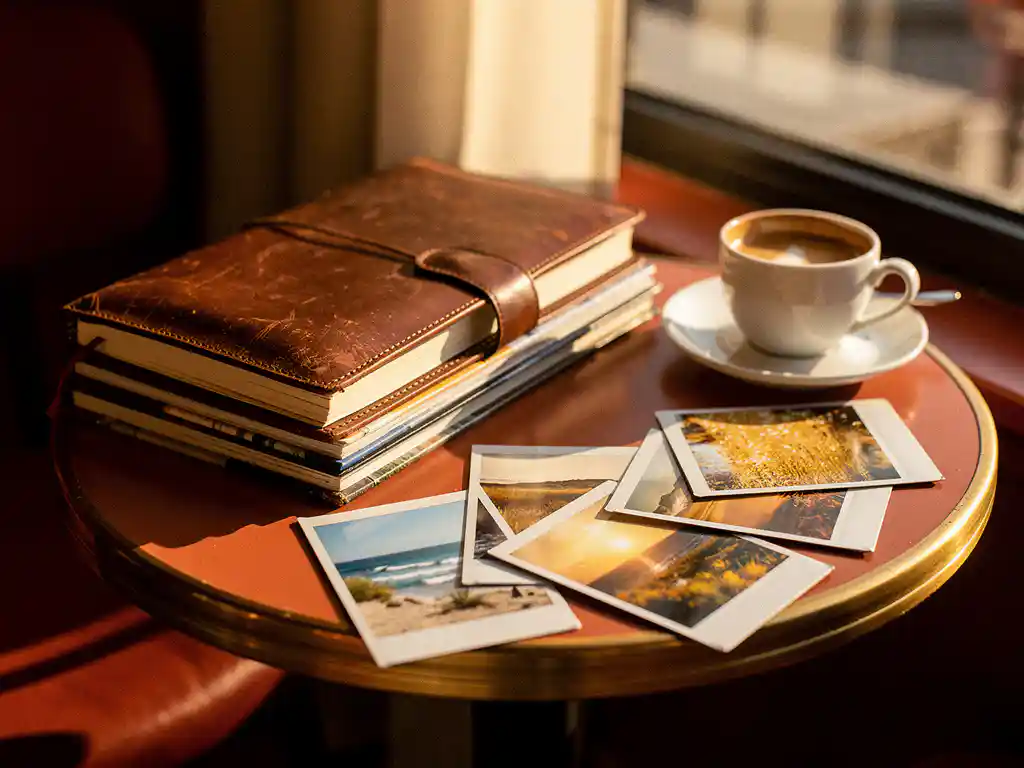
Travel memories matter because they are among the most emotionally vivid and personally meaningful experiences a person can have. Unlike routine daily events, travel pulls you out of familiar surroundings and forces you into new situations, new sensations, and new perspectives — and that novelty is precisely what makes those moments stick. The questions below unpack why travel memories fade, what makes them psychologically unique, and how to preserve them so they last a lifetime.
Why do travel memories fade so quickly?
Travel memories fade quickly because the brain prioritizes novelty during the experience itself but struggles to retain details without reinforcement afterward. When you return to your normal routine, the flood of new daily information competes with and gradually overwrites the vivid impressions from your trip. Without active recall or a physical reminder, even powerful travel experiences can blur within weeks.
This is not a flaw in memory — it is how the brain manages an enormous volume of sensory input. During travel, your brain processes unfamiliar sights, sounds, smells, and social situations at a much higher rate than usual. That intensity feels memorable in the moment, but the details begin to erode once you are back in a familiar environment where those neural pathways are no longer being reinforced.
Research in memory science consistently shows that memories strengthen through repetition and emotional association. The more you revisit a memory — whether through conversation, photographs, or a physical keepsake — the more durable it becomes. This is why actively preserving travel memories, rather than passively hoping they stick, makes such a significant difference.
What makes travel memories different from everyday memories?
Travel memories are different from everyday memories because they are formed during periods of heightened novelty, emotional intensity, and sensory richness. The brain encodes experiences more deeply when they are unfamiliar, meaningful, or emotionally charged — and travel reliably delivers all three. This is why a single week abroad can feel more memorable than months of ordinary routine.
Psychologists refer to a phenomenon called the reminiscence bump — the tendency for people to recall a disproportionate number of vivid memories from periods of significant change or first-time experiences. Travel is one of the most reliable triggers for this effect. A first visit to a new country, a spontaneous detour, an unexpected encounter — these moments carry a weight that mundane daily events simply do not.
There is also a time-expansion effect at work. Holidays often feel longer and richer in retrospect than the same number of days spent at home. This happens because novel environments generate more distinct memory markers, making the brain perceive that period as more substantial. That is part of why people who travel regularly describe feeling like they have lived more fully.
How do travel memories affect mental health and wellbeing?
Travel memories have a measurable positive effect on mental health and wellbeing by providing a reliable source of positive emotion, reduced stress, and a strengthened sense of identity. Revisiting happy travel experiences — even just mentally — activates the same reward pathways as the original event. This makes travel memories a genuine psychological resource, not just nostalgic indulgence.
Nostalgia, once dismissed as a form of melancholy, is now understood by researchers as a fundamentally restorative emotion. It increases feelings of social connectedness, boosts self-continuity, and counteracts loneliness. Travel memories are particularly potent triggers for nostalgia because they are tied to freedom, discovery, and shared experiences with people you care about.
Beyond nostalgia, reliving travel experiences can also serve as a buffer against everyday stress and monotony. Having a rich archive of meaningful experiences to draw on gives people a broader sense of who they are beyond their immediate circumstances. For many people, the anticipation of a future trip and the reflection on past ones are just as valuable to wellbeing as the travel itself.
What are the best ways to preserve travel memories?
The best ways to preserve travel memories combine active documentation during the trip with deliberate curation afterward. Photographs are the most common tool, but they only work as memory anchors when they are organized and revisited. Journaling, collecting physical mementos, and creating printed keepsakes all reinforce the neural pathways that keep travel memories vivid over time.
Here are the most effective approaches:
- Take intentional photos: Rather than photographing everything, focus on capturing the moments that carry the most emotional weight — the people, the meals, the unexpected discoveries.
- Write brief notes in the moment: A few sentences about how a place felt, what you ate, or what surprised you will be far more valuable in five years than a hundred uncontextualized images.
- Organize photos soon after returning: The longer you wait, the harder it becomes to remember the context behind each image. Sorting and labeling photos within a week of returning dramatically improves long-term recall.
- Create a physical keepsake: Printed travel keepsakes — whether a photo book, a poster, or a calendar — give memories a tangible form that digital files simply cannot replicate. Physical objects trigger recall in ways that scrolling through a phone gallery does not.
- Share the experience: Telling stories about your trip, sharing photos with friends and family, or contributing to a collaborative album reinforces the memory and gives it social meaning.
The key principle across all of these methods is active reinforcement. Memories that are revisited, shared, and given a physical or narrative form become part of your long-term story rather than fading into a blur of forgotten images.
How do you turn hundreds of travel photos into something meaningful?
You turn hundreds of travel photos into something meaningful by curating rather than keeping everything. The goal is not to archive every image but to identify the ones that genuinely capture the spirit of the trip — the people, the places, the unexpected moments — and give them a coherent structure. A curated travel photo book does this far more effectively than an unorganized camera roll.
Most people return from a trip with far more photos than they will ever meaningfully revisit. The sheer volume becomes an obstacle rather than an asset. The solution is curation: selecting a representative set of images that tells the story of the trip from beginning to end, removing duplicates and low-quality shots, and grouping photos by location or day to give the collection a natural narrative arc.
A printed photo book is one of the most powerful formats for this because it imposes a structure that a digital album does not. Turning the pages of a physical book is a fundamentally different experience from scrolling through a phone — it slows you down, invites reflection, and makes the memories feel real and substantial. It is also something you can share with others in a way that a phone screen rarely allows.
The practical challenge has always been the time and effort required to go from a chaotic camera roll to a finished, printed product. That gap is exactly what modern AI-powered tools are designed to close.
How PastBook helps you preserve your travel memories
We built PastBook specifically to solve the gap between having thousands of travel photos and actually doing something meaningful with them. Our AI-powered platform takes the effort out of the entire process — so your memories become a beautiful, printed keepsake without hours of manual work.
Here is what we offer:
- Instant curation in under 60 seconds: Select a date range, location, or album, and our AI automatically analyzes image quality, removes duplicates, and arranges your best shots into a beautifully designed layout.
- Multiple import sources: Pull photos from your phone, Instagram, Facebook, Google Drive, or Dropbox — no matter where your travel memories are stored.
- Premium printed photo books: Choose from soft cover, hardcover, or premium hardcover formats in A4 or A5 size, printed on FSC-certified paper and shipped worldwide.
- Collaborative albums: Travelling with friends or family? Everyone can contribute their photos to a single shared album, available both online and in print.
- Location-based books: Start a photo book directly from a specific destination, making it effortless to document individual trips as distinct, self-contained stories.
The result looks like you spent hours carefully designing it — because we handle everything behind the scenes. Whether you want to relive a solo adventure, a family holiday, or a bucket-list trip, we turn your scattered photos into a printed travel photo book you will actually return to. Start yours today and make sure your travel memories last.